MAIN PERFORMANCE INDICATORS


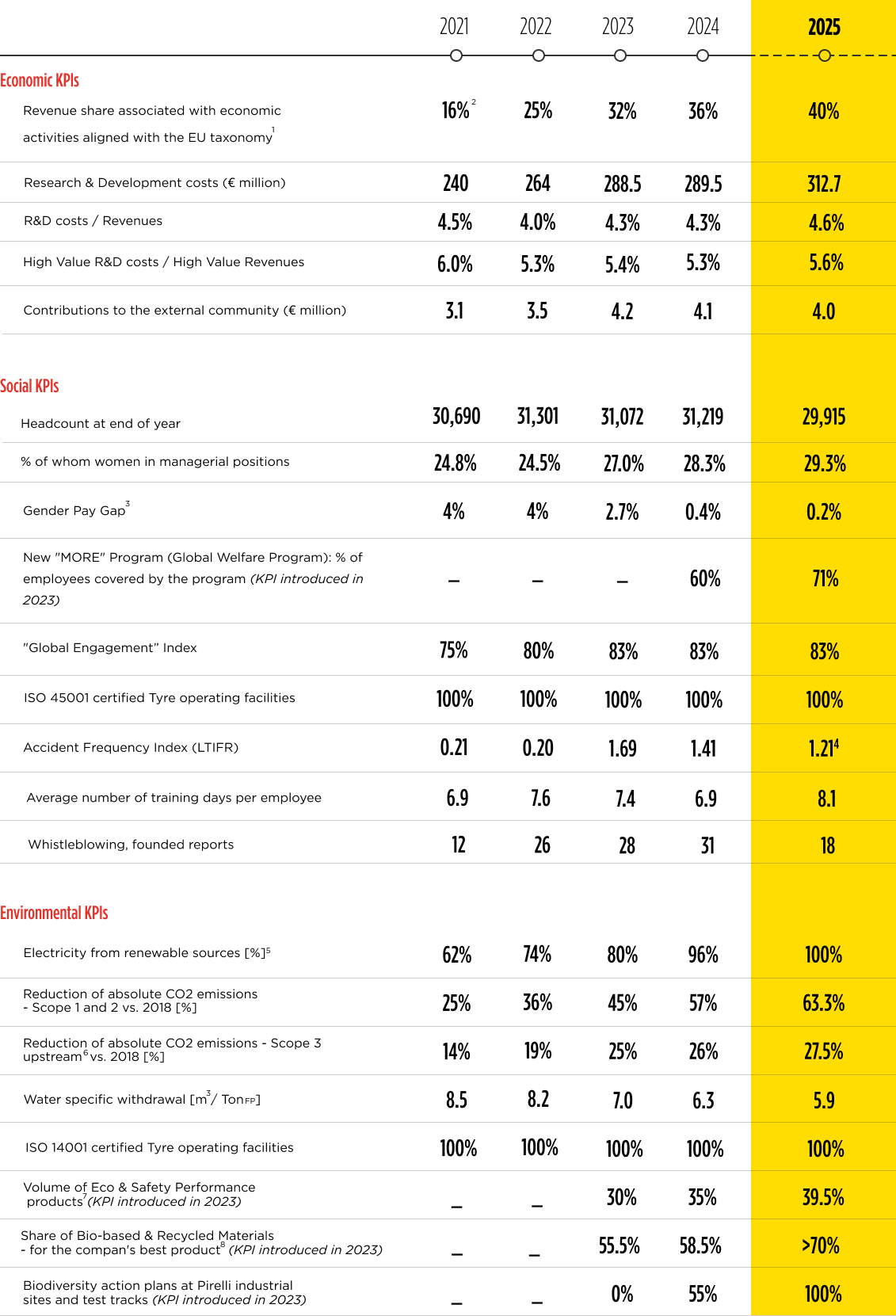
main performance indicators table

1. EU Regulation 2020/852
2. Data reporting started in 2021
3. With reference to the Group's employees, the Pay Gap value is in favor of women.
4. Lost Time Injury Frequency Rate (LTIFR): Since 2023, the representation method has been changed (/1,000,000 hours worked instead of 100,000). If the index were calculated based on 200,000 hours worked, the 2024 value would be 0.28, ~0.2 in 2025, and <0.2 in 2030
5. Purchased from the electrical grid.
6. Included Scope 3 categories: 1 – purchased goods and services; 3 – fuel and energy not included in Scope 1 and 2; 4 – upstream transportation and distribution.
7. Value influenced by the context of the Covid-19 pandemic.
8. Percentage of the volume of passenger car tyres sold with rolling resistance and wet grip belonging to classes A+B.
9. Pirelli product available on the market with the highest content of natural (bio-based) and recycled materials in the reference year


2024 ACHIEVEMENTS

Acceleration of the decarbonization pathway of the value chain

  • Validation by the Science Based Targets initiative of the «Net Zero»  target by 20401, the most challenging among tyre makers 
  • 96% of the electricity purchased from the grid is certified as coming from renewable sources.

Progression of the Product Sustainability roadmap.

  • Increased to 34.5% The share of tyres placed on the market in line with the highest classes (A or B) of the European labeling for rolling resistance and wet braking

Commitment to Research & Development on innovative, natural, and recycled materials

  • P Zero E tyre: content of natural or recycled materials at 58.5%, in the size 255/50R20
  • Introduction of tyres with FSC™ natural rubber in the Formula 1® championship, starting from the first GP of 2024 and debut of FSC™ certification in the cycling world with the new Pirelli P Zero Race RS2

Proactive commitment to biodiversity protection

  • Biodiversity Action Plans: coverage of 55% of Pirelli's production sites and test tracks, in line with the target of 100% by 2025
  • For 100% of new products, biodiversity has been integrated into the life cycle impact assessment (LCA-Life cycle assessment).

1. Reduction of Scope 1, 2, and 3 emissions along the entire value chain by at least 90% compared to 2018.
2. Natural rubber represents the following percentage of the total tyre weight: approximately 15% in Formula 1 tyres; approximately 23% in P Zero Race RS tyres 

SUSTAINABILITY TARGETS AT 2025-2030

On March 6, 2024 - The Board of Directors of Pirelli & C. approved the update of the Industrial Plan to 2024-2025 and the related sustainability strategy to 2025, 2030 and 2040, developed in continuity with the sustainable transition process and in support of the United Nations 2030 goals.
The Plan considers the material impacts of the Company and aims to capture growth opportunities arising from global scenarios including, but not limited to, the growth in demand for Sustainable Mobility, evolving social factors, and key regulations that will impact the horizon of the plan.
Our goals are based on four main pillars:

  1. Climate: acceleration toward net zero
  2. Product: pioneering approach to sustainability in High Value tyres
  3. Nature: redefining interactions between business and natural capital
  4. People: the heart of our growth
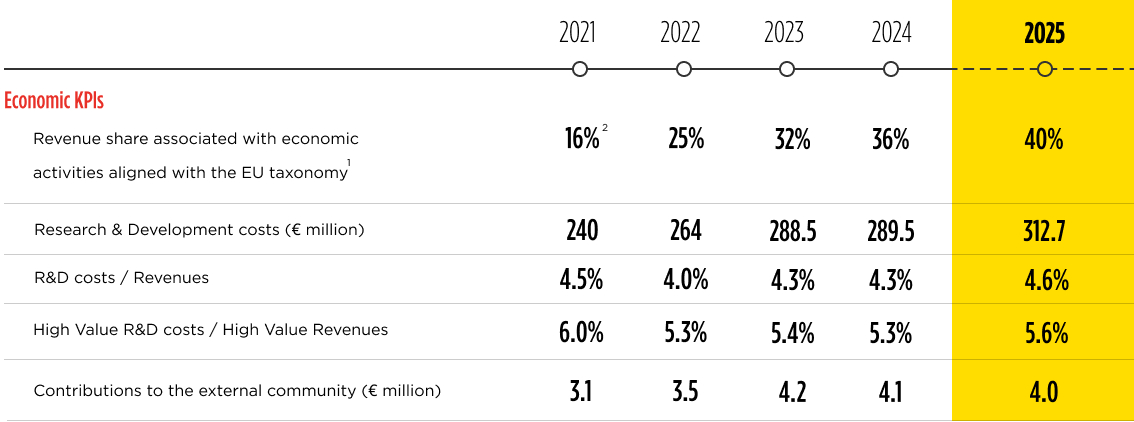
main economic performance indicators table

1. EU Regulation 2020/852
2. Data reporting started in 2021
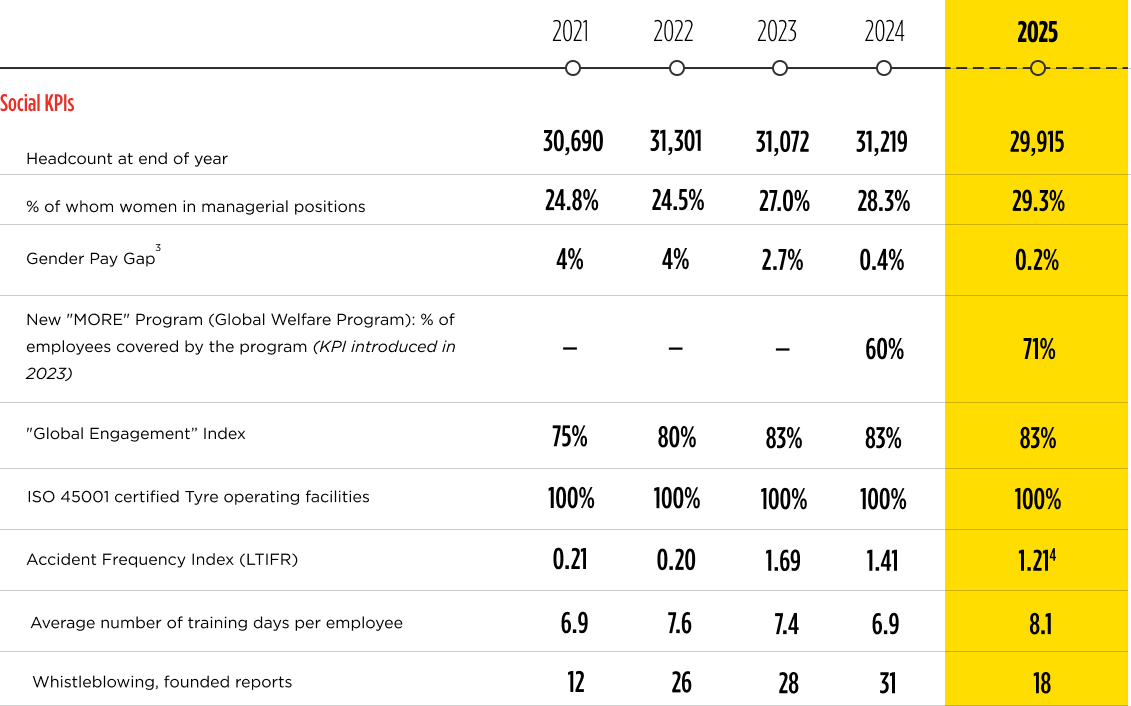
main social table

3. With reference to the Group's employees, the Pay Gap value is in favor of women.
4. Lost Time Injury Frequency Rate (LTIFR): Since 2023, the representation method has been changed (/1,000,000 hours worked instead of 100,000). If the index were calculated based on 200,000 hours worked, the 2024 value would be 0.28, ~0.2 in 2025, and <0.2 in 2030

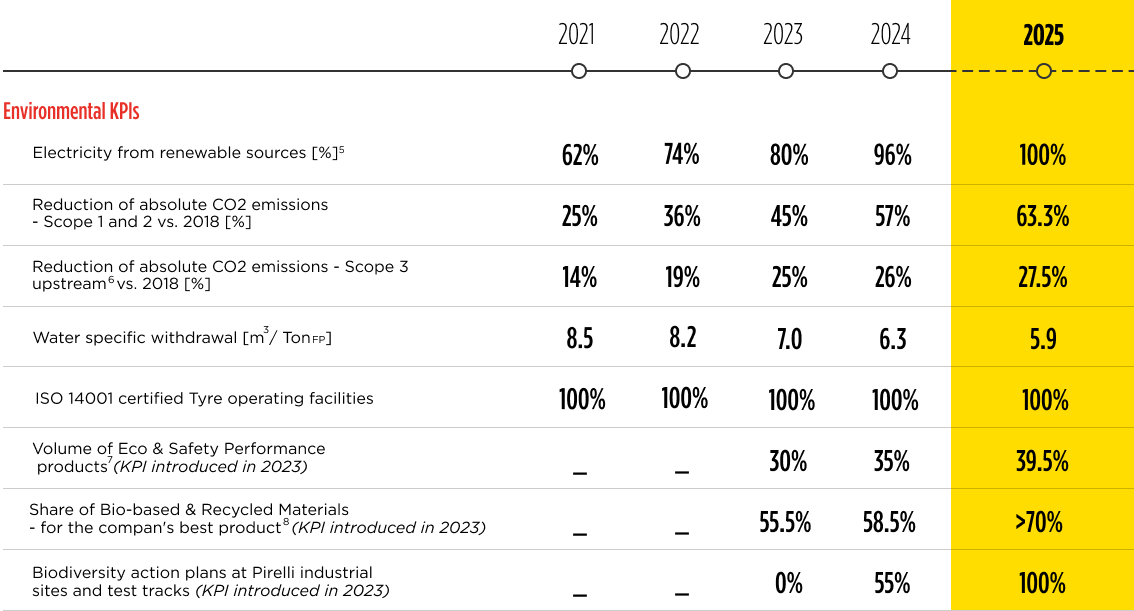
main environment table

5. Purchased from the electrical grid.
6. Included Scope 3 categories: 1 – purchased goods and services; 3 – fuel and energy not included in Scope 1 and 2; 4 – upstream transportation and distribution.
7. Value influenced by the context of the Covid-19 pandemic.
8. Percentage of the volume of passenger car tyres sold with rolling resistance and wet grip belonging to classes A+B.
9. Pirelli product available on the market with the highest content of natural (bio-based) and recycled materials in the reference year


  1. ENVIRONMENTAL IMPACT OF PIRELLI’S PRODUCTION SYSTEM

    1. As part of the Double Materiality Analysis conducted in 2025, we provide a comprehensive overview of the topics that, while not classified as material under the assessment criteria, were nonetheless identified as significant due to their potential impact on the Group’s activities.

      The performances reported in the following sections concern the three-year period 2023-2024-2025 and cover the same scope of the Group’s consolidation, including the impacts of all the units under operational control: from industrial realities to commercial and administrative sites. The amount of finished product used in the calculation of the specific indices indicated below, in 2025 was 756,077 tonnes.

      1. Waste Management

        1. The circular management of resources is one of the tyre industry’s most pressing challenges, both in product design and in waste management, aiming to minimise waste generation, maximise its recovery and thus reduce its environmental impact.

          As part of ISO 14001-certified environmental management systems implemented at the factories, specific waste management programs have been adopted.

          Areas for improvement in waste management and opportunities to enhance waste performance are identified through the mapping and measurement of waste production flows at production sites. In 2025, this activity was supported by a third-party audit on waste classification, management, recovery and disposal, carried out in accordance with local site-specific regulations. The outcomes of this analysis contribute to the definition of site-specific waste recovery targets.

          In particular, the improvement of environmental performance related to waste management is pursued through action plans that include:

          • the innovation of production processes, led by Quality, R&D, and Manufacturing through dedicated investments and specific projects, aims to prevent waste generation at the source, progressively reduce processing rejects and replace current raw materials with lower environmental impact alternatives. These cross functional initiatives help identify opportunities to improve waste performance throughout the production cycle. Within this context, dedicated employee awareness campaigns and training programs focused on waste reduction were carried out as part of the cross functional initiatives to reduce waste. The program also included workshops and internal benchmarking activities, both at headquarters and across global manufacturing sites, aimed at identifying key actions to prevent waste generation and achieve a positive impact on overall waste reduction.
          • operating management of generated waste, an integral part of the management systems of environmental certificates, aimed at identifying and ensuring the selection of waste treatment channels, in line with current local regulations, that can maximise recovery and recycling, gradually eliminating the amount sent to the landfill with the Zero Waste to Landfill vision.
          • streamlining packaging management, both for the packaging of purchased products and the packaging for products made by the Group. The initiatives guided by Pirelli’s Single Use Plastic Free Policy also fall within this context.

          At Group level, 2025 saw a reduction of around 2% both in absolute waste production and specific waste production compared to the previous year.

              2023 2024 2025
          Absolute production ton 109,780 105,443 103,431
          Specific production Kg/tonFP 147 140 137

          Of the total waste produced in 2025, 97.5% was sent for recovery (waste to landfill diversion rate) at third-party plants, slightly lower than the group target which envisages a 98% rate of sending the waste produced for recovery by 2025. The waste to landfill diversion rate is third party verified according to ISO 14065:2020 standard. Nevertheless, the amount of waste sent to landfill in 2025 decreased by around 32% compared to the previous year, highlighting the effort to pursue the “Zero to Landfill” vision of the Group.
          In 2025, hazardous waste1 accounts for 12% of the total waste produced and it is totally sent for treatment in third-party plants, authorised in accordance with local regulations.

          The following table summarises the main data on the management of waste produced in 2025 which are entirely managed by external treatment plants.

          Type of processing at external sites   Non-Hazardous
          Waste
          Hazardous
          Waste
          Total Waste
          Preparation for re-use ton 272 0 272
          Recycling ton 39,005 785 39,790
          Other recovery operations ton 26,459 7,770 34,229
          Total waste not for disposal ton 65,736 8,555 74,291
          Incineration with energy recovery ton 24,258 2,343 26,601
          Incineration without energy recovery ton 4 94 98
          Landfilling ton 711 637 1,348
          Other disposal operation ton 107 987 1,094
          Total waste destined for disposal ton 25,080 4,061 29,141
          Total produced waste ton 90,815 12,616 103,431
          Total waste sent to recovery (of material & energy) ton     100,892
          Waste-to-landfill-diversion rate %     97.5%

           WASTE - THIRD PARTY VERIFICATION (101 KB)

          1 The hazardousness of waste is generally defined according to the applicable local regulations (e.g. in Europe it is done according to the Waste Framework Directive 2008/9EC).

      1. Solvents

        1. Solvents are used as ingredients in processing, mainly to reactivate vulcanised rubber, during the manufacture and finishing of tyres. Through dedicated resources and budgets, Pirelli’s R&D is committed to the progressive reduction of these substances, both by optimising their use, and by spreading solvent-free technologies for operations that may be performed even without their use, with a target to keep the value of annual specific solvent consumption below 1 kg per tonne of finished product.

          In 2025, the specific solvent consumption amounted to 0.87 kg per tonne of tyres produced, a value 13% below the Group target and only 3% higher than that recorded in 2024. The value of VOCs2 related to the use of solvents is slightly lower than total consumption of the same.


              2023 2024 2025
          Absolute consumption tonSOLV 693 630 654
          Specific consumption kgSOLV/tonFP 0.93 0.84 0.87

          2 Volatile Organic Compounds.

      1. NOx, SOx and other air pollutant emissions

        1. NOx emissions originate directly from the processes of energy generation. In 2025, the index calculated in relation to tons of finished product recorded a 10% compared to 2024, mainly due to a change in the energy mix, with a significant increase in the share of renewable sources (+6% compared to the previous year) and a reduction in specific energy consumption (-2.9% compared to 2024). Emissions were calculated by applying the emission factors provided by the EEA3 to the energy consumption data. In absolute terms, NOx emissions in 2025 decreased by 10% compared to the previous year.


              2023 2024 2025
          Absolute emissions tonNOx 549 484 436
          Specific emissions kgNOx/tonFP 0.74 0.64 0.58

          With regards to direct SOx emissions, resulting from the combustion of diesel oil and fuel oil, the value recorded in 2025 is 10.5 tons (13.9 tons in 2024 and 7.9 tons in 2023, respectively). The estimates are based on the emission factors provided by EEA.

          As for the emissions potentially capable of affecting the ozone layer, it should be noted that the tyre production process does not involve the direct use of ozone-depleting substances. However, such substances may be present in closed circuits of cooling and air-conditioning systems. Therefore, unless accidental and unforeseeable leaks occur, no emissions into the atmosphere attributable to Pirelli’s production activities are reported.

          Regarding the efficiency of production plant in terms of air pollutant emissions, it should be noted that Pirelli’s Chinese sites of Jiaozuo and Yanzhou are certified as “Class A” according to the guidelines issued by the Chinese Ministry of the Environment for the management of emission during critical air quality conditions. As a result of the technical and managerial measures implemented by Pirelli, both sites are not subject to production restrictions during periods in which the air quality in the provinces where they operate (Henan and Shandong respectively) exceeds alert thresholds.


          3 European Environment Agency.

  1. ENVIRONMENTAL FOOTPRINT APPROACH

    1. Monitoring and management of environmental issues has always played a key role in the business strategy at Pirelli. With a view to long-term management of impacts, Pirelli each year monitors the Carbon Footprint and Water Footprint of its entire organisation and is committed to the progressive reduction of the related impacts on resources, climate and ecosystems. The Group has adopted a control and monitoring system that allows the identification of the materiality of environmental impacts throughout the product life cycle.

      At the methodological level, the phases of the life cycle were analysed following the Life Cycle Assessment methodology as defined by the ISO 14040 family rules, the latter approach being able to corroborate in the most objective way possible the results and the strategic decisions connected to it, integrated with the indications of the “Product Category Rule” 4 for tyres developed by the Tyre Industry Project Group of the WBCSD5. This approach is based on the identification and quantification of all input and output flows of the various life cycle phases (resources, raw materials, emissions, waste), which are subsequently translated into environmental impact potentials using dedicated models. This method therefore makes it possible to consolidate the effects of a very large number of factors (for example, of all the types of emissions or waste that are generated in the production processes of the raw materials used) into a few synthetic quantitative parameters (e.g. Global Warming Potential, Resource Use, Water Use, Eutrophication Potential). For the determination of the Carbon Footprint and Water Footprint, Pirelli's calculation model is inspired by the ISO 14067 and ISO 14046 standards, respectively.


      4 Set of specific rules, requirements and guidelines for the development of environmental declarations, for one or more product categories, defined according to ISO 14025
      5 World Business Council for Sustainable Development